When most people think about calcium, they think about bones.
That makes sense. Bones store the vast majority of the body’s calcium. But the calcium circulating in the bloodstream is doing something far more important on a moment-to-moment basis.
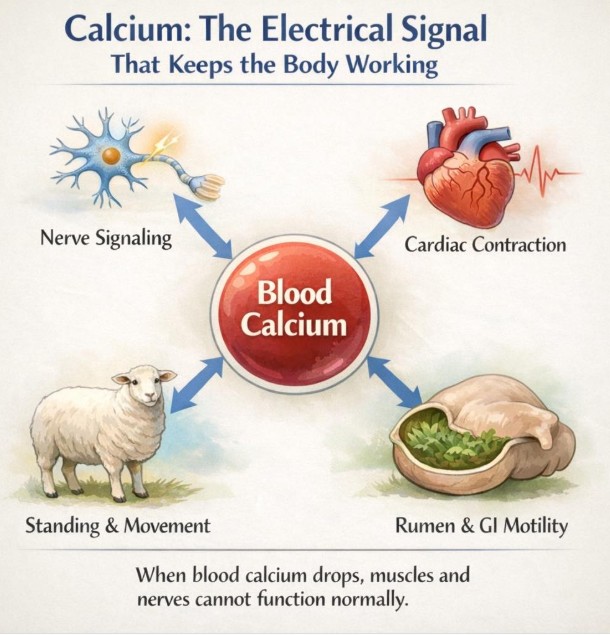
Calcium acts as one of the body’s primary signaling molecules.
It allows nerves to communicate with muscles and organs throughout the body. When calcium levels fall too low, those signals begin to fail.
This is why hypocalcemia — often called milk fever — can affect multiple body systems at once.
To understand hypocalcemia, we first need to understand what calcium actually does in the body.
⸻
Calcium and Nerve Signaling
Every movement in the body begins with a nerve signal.
For a nerve to transmit that signal, calcium must move across the nerve cell membrane. If blood calcium drops too low, those signals become weaker and less effective.
This is why animals developing hypocalcemia may appear:
• slow
• weak
• uncoordinated
• reluctant to move
The nervous system simply cannot communicate with the muscles the way it normally does.
⸻
Calcium and Muscle Contraction
Muscles depend directly on calcium in order to contract.
This includes:
• Skeletal muscle – the muscles that allow the animal to stand and move
• Cardiac muscle – the heart
• Smooth muscle – the muscles that control many internal organs
When calcium levels drop, muscles cannot contract normally. The result can range from weakness and trembling to animals becoming unable to stand.
But skeletal muscle weakness is only part of the story.
⸻
The Rumen Is a Muscular Organ
The rumen is often thought of simply as a fermentation chamber, but its walls are made of smooth muscle.
These muscles contract rhythmically throughout the day. These contractions mix feed, move digesta through the digestive tract, and help maintain normal rumen function.
Those contractions also depend on calcium.
When blood calcium falls, rumen contractions slow down or become irregular. As rumen motility decreases, animals often lose their appetite and eat less.
This becomes especially important in late gestation, when the rumen already has less space available because of the growing fetuses.
⸻
Calcium and the Heart
The heart is also a muscle, and it depends on calcium to contract properly.
Calcium plays a role in the electrical activity that controls the heartbeat. Severe hypocalcemia can interfere with this process.
This is one reason veterinarians are careful when administering intravenous calcium treatments. Calcium levels must be corrected carefully rather than simply flooded into the bloodstream.
⸻
A System Problem, Not Just a Bone Problem
When blood calcium levels begin to fall, several systems begin to slow down at the same time:
• Nerve signaling becomes less efficient
• Muscles weaken
• The rumen slows or stops contracting
• Feed intake drops
For animals in late gestation or early lactation, this combination can become dangerous because their metabolic demands are already high.
Hypocalcemia is not simply a problem of low calcium in the blood. It is a system problem, where the body cannot move calcium quickly enough to meet demand.
⸻
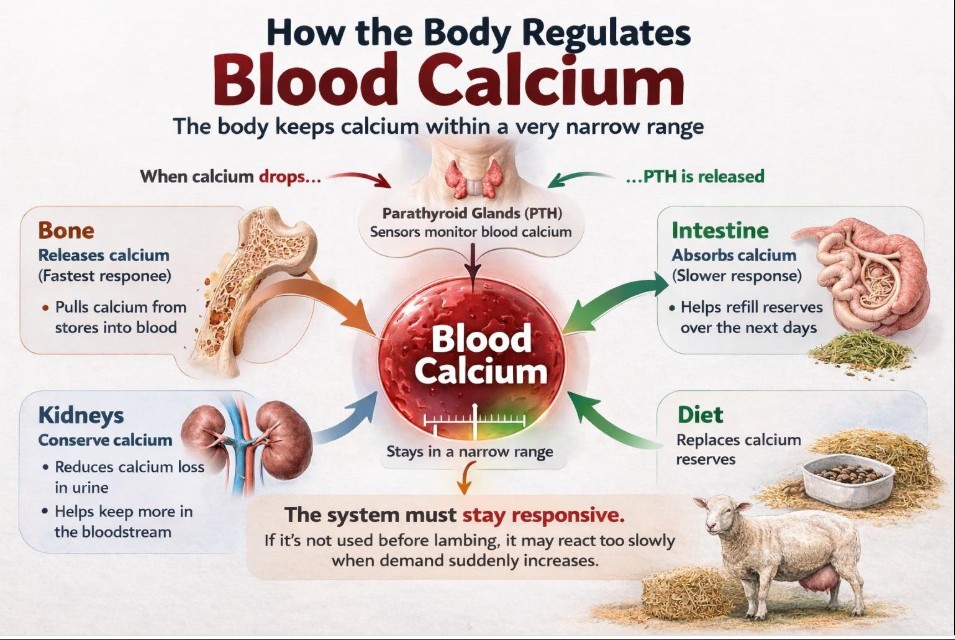
The body has an elegant system involving hormones, bone reserves, and intestinal absorption that normally keeps blood calcium within a very tight range.
But around lambing and kidding, that system can be pushed to its limits.
Understanding how that regulation works is the key to understanding why hypocalcemia occurs in the first place.Because calcium is so important, the body keeps blood calcium within a very narrow range. Even small changes can affect how the body functions.
Fortunately, animals have a very effective system for regulating calcium levels. This system relies on three major components:
• Bone calcium reserves
• Hormonal signaling
• Calcium absorption from the digestive tract
Understanding how this system works helps explain why hypocalcemia develops.
⸻
Bone: The Body’s Calcium Reservoir
Most of the calcium in the body is stored in bone.
Bone is not just a structural material that supports the body. It also serves as a large mineral reservoir that the body can draw from when needed.
When blood calcium levels begin to fall, the body can quickly release calcium from bone and move it back into the bloodstream. This process allows animals to correct many small calcium fluctuations without any visible symptoms.
In other words, most animals already have large calcium reserves available.
⸻
The Hormone That Controls the System
The primary regulator of blood calcium is parathyroid hormone, commonly called PTH.
Small glands located near the thyroid constantly monitor calcium levels in the blood. When calcium begins to drop, these glands release PTH.
PTH signals the body to take several actions:
• release calcium from bone
• increase calcium absorption from the intestine
• reduce calcium loss through the kidneys
Together, these responses help restore blood calcium to a healthy range.
⸻
The Role of the Digestive Tract
While bone provides the quickest response to falling calcium levels, the digestive tract plays an important role in longer-term calcium balance.
Hormonal signals increase the intestine’s ability to absorb calcium from feed. This process takes more time than bone mobilization, but it helps replenish calcium reserves over the following days.
In this way, the body is constantly balancing mobilization from bone with replacement from the diet.
⸻
A System That Usually Works Very Well
Under normal conditions this calcium regulation system works extremely well.
Animals experience small fluctuations in calcium every day, but the body adjusts quickly and keeps blood calcium levels within a healthy range.
Most of the time, the animal never notices these adjustments happening.
⸻
When Demand Suddenly Increases
Problems begin when calcium demand rises very quickly.
Late gestation and early lactation are two of the most demanding periods in an animal’s life. Large amounts of calcium may suddenly be required for:
• fetal development
• colostrum production
• milk production
If the body cannot move calcium from bone into the bloodstream quickly enough to meet this demand, blood calcium levels begin to fall.
This is when hypocalcemia begins to develop.
⸻
The Key Concept
One of the most important things to understand is that hypocalcemia is usually not a simple lack of calcium in the animal’s body.
Most animals have large calcium reserves stored in bone.
Instead, hypocalcemia usually occurs when the body cannot mobilize those reserves quickly enough to meet demand.
⸻
Keeping the System Responsive
The calcium regulation system works best when it remains active and responsive.
If the system has been idle for long periods of time, it may respond more slowly when calcium demand suddenly increases.
This becomes especially important in the weeks leading up to lambing or kidding.
Many producers assume that providing large amounts of calcium before birth will help prevent hypocalcemia. In reality, the opposite can sometimes occur. When calcium intake is consistently very high, the body may not need to mobilize calcium from bone very often.
When lactation begins and calcium demand suddenly increases, the mobilization system may simply react too slowly.
⸻
Now we need to talk about why that system sometimes fails.
One of the most important ideas for producers to understand is that hypocalcemia is usually not caused by a simple lack of calcium in the diet.
In many cases the animal already has large calcium reserves stored in bone.
The real problem is often that the body cannot mobilize calcium quickly enough when demand suddenly increases.
This is a timing issue — not just a supply issue.
⸻
When Demand Changes Overnight
Late gestation and early lactation represent one of the most dramatic metabolic transitions in a ewe or doe’s life.
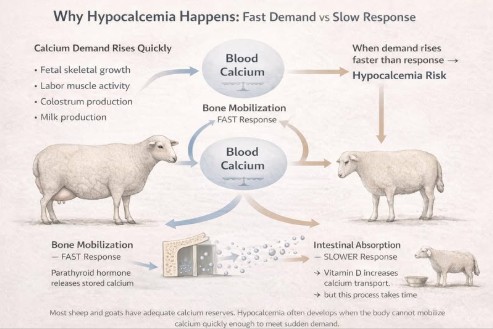
Calcium demand can rise rapidly due to:
• fetal skeletal growth
• uterine muscle activity during labor
• colostrum production
• milk production
• reduced feed intake near parturition
At the same time, rumen space is decreased because of the growing fetuses.
This alone can reduce dry matter intake during the very period when mineral and energy demands are increasing.
If the regulatory system is not primed and responsive, blood calcium levels may fall faster than the body can correct them.
⸻
The Fast Response vs the Slow Response
When calcium levels begin to drop, the body activates several emergency mechanisms.
The fastest response is the release of calcium from bone under the influence of parathyroid hormone (PTH).
This is the body’s “fire extinguisher” — rapid mobilization of stored calcium into the bloodstream.
A slower response involves increasing calcium absorption from the digestive tract.
Hormonal signals activate vitamin D, which helps the intestine move more calcium into the blood over the following hours and days.
This means survival during sudden calcium demand depends largely on how quickly the animal can mobilize calcium from body reserves — not just how much calcium is present in the diet.
⸻
The Intestinal “Doorway”
A helpful way to picture calcium absorption is to think of the intestinal lining as a controlled doorway.
Calcium in the digestive tract is like a crowd of people trying to pass through that doorway into the bloodstream.
No matter how many are waiting outside, only a certain number can move through at a time.
Hormones determine how wide that doorway opens.
Parathyroid hormone and activated vitamin D gradually increase the intestine’s ability to absorb calcium, but this process takes time.
It is not an instant correction for falling blood calcium.
⸻
Why Too Much Calcium Can Sometimes Cause Problems
It may seem logical that feeding large amounts of calcium before lambing or kidding would prevent hypocalcemia.
However, when animals receive consistently high calcium intake, the body may rely less on mobilizing calcium from bone.
Over time, this can reduce the responsiveness of the regulatory system.
Then when lactation begins and calcium demand rises sharply, the body’s response may be too slow to keep up.
In metabolic disease, slow response often equals clinical signs.
This is why hypocalcemia is best thought of as a regulation disorder rather than simply a deficiency disorder.
⸻
The Rumen and Digestive Effects
Calcium also plays a major role in smooth muscle contraction, including the muscles that control rumen and intestinal motility.
When blood calcium begins to fall, rumen contractions may slow or become uncoordinated.
Feed intake often decreases, and digestive efficiency may decline.
This can create a cascade of metabolic stress that overlaps with other conditions such as pregnancy toxemia.
In real-world situations, metabolic diseases rarely occur in isolation.
⸻
Genetics and Modern Production Pressure
Modern sheep and goats are often selected for:
• increased milk production
• larger litter sizes
• faster growth rates
• improved body condition
While these traits improve productivity, they also increase metabolic demand.
The calcium regulation system must not only function —
it must respond rapidly and efficiently to sudden changes.
⸻
Mineral Balance Matters
Calcium metabolism does not operate alone.
Adequate magnesium status is important for proper hormonal responsiveness, and broader mineral balance supports overall metabolic stability.
This is another example of why prevention strategies must focus on the whole nutritional system rather than a single nutrient.
⸻
The Take-Home Message
In many cases hypocalcemia does not occur because calcium is missing from the animal’s body.
It occurs because the animal cannot mobilize and regulate calcium fast enough when demand suddenly increases.
Good management is not about extremes.
It is about maintaining a nutritional and metabolic environment that keeps the system responsive and adaptable.
In the next article we will discuss how hypocalcemia actually appears in the animal, including early warning signs and how it can sometimes be confused with other metabolic disorders.
Understanding what you see in the barn is the next step toward preventing serious outcomes.
 Minn E Acres Farm